
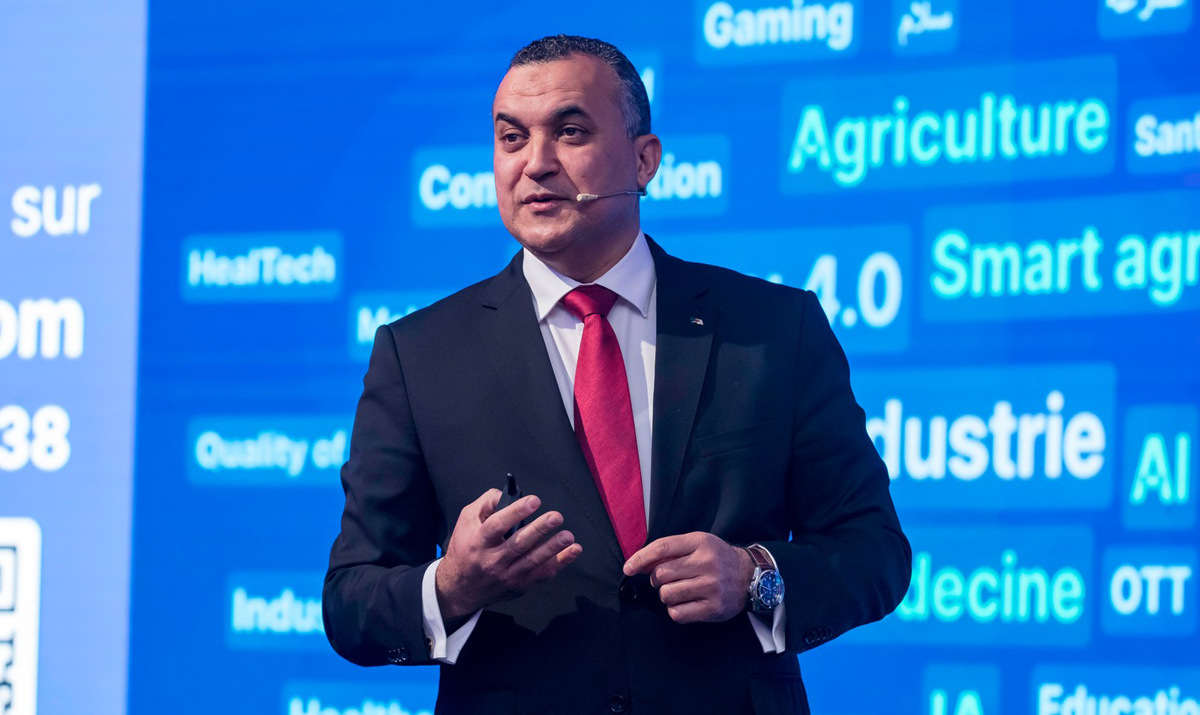
15 Jul Interview with Sid Ali Zerrouki, Minister of Post and Telecoms, Algeria
Algeria is undergoing one of the most ambitious digital transformations in Africa. How do you see the telecoms sector driving the country’s transition towards a knowledge-based digital economy?
Our vision has changed over the past six years as the country has been moving at a different pace. Today, telecommunications constitutes a pillar of the economy. Without telecommunications we cannot connect populations, industries and countries to each other. We consider our department to be critical for the whole government and for GDP growth. We have embraced this new reality and we are promoting Algeria not only in Africa, but also in the Mediterranean region. We don’t want to be number-one; we want to lead and bring inclusivity to others, not only from Africa, but from all over the world. We are a communications hub. We have the postal sector and Algeria Post, which is one of the biggest institutions on the continent, with more than 20 million accounts. Then we have telecommunications and we are proud that inter-communication in Algeria will cover four pillars.
Just recently, we had the Global Africa Tech, where the theme was network-wide conversions, including submarine cables, data centers, AI and cloud computing, fiber optics for homes; air, which is mobile services; and space, which will connect everyone with the objective of not leaving anyone behind. This is how telecommunication is reshaping or positioning Algeria at the forefront of the continent and the region.
With more than 2.3 million households already connected to fiber, what impact is this infrastructure having on productivity, innovation and quality of life across Algeria?
The ambition is to prioritize digitalization. Each and every single government department relies on telecommunication and connectivity, not only the instructions, but also the individuals within them and their households. Nowadays everyone has smartphones and tablets, so not having connectivity feels like something that only happened in the past. Algeria is a huge country, so providing coverage for all our people is a challenge, but we are sparing no effort in deploying fiber optic mobile connectivity. The government has committed to switching of all copper lines by 2027, but by the end of 2026, we will have all households connected to fibre. This will change the user experience and provide opportunities.
On top of that, Algeria users have high expectations, although many of them don’t know the difference between 50 MB and 100 MB, but it’s our role to give them what they have paid for. We are the first country in Africa that provides 1.6 gigabits per second to domestic customers. We have different technologies: domestic fiber, copper, which we are swapping and we have the 4GLT because there are some houses that you can’t affordably reach with fiber. We are launching a tender for a non-geostationary satellite orbit whose purpose is to cover all areas that are lagging behind and cannot be connected to the network, either by fiber or by mobile phone. Today, even a village of 20 people in the middle of the desert can use our mobile satellite network and expect high-speed connectivity. With this step, we will be looping the loop and bringing everyone on board with the digitalization agenda.
Algeria’s early rollout of 5G positions it as one of the leaders in the continent. What opportunities do you expect 5G to unlock in areas such as smart cities, industry and digital services?
We are working in two different frequencies today. The luxury frequency is 2.6 gigahertz and is supporting the 4G network, which is already there and the license will expire in the next couple of years for some operators. But we did not stop there and the quality has increased significantly. 5G is now a must. This is not just for streaming or broadcasting or chatting; it is meant for industrial empowerment. 5G will impact the Algerian economy and by 2030 will go from $13 billion to $30 billion. 5G itself will add about $15 billion.
We are supporting the economy through the Baladna project in the south. To connect them all at the same time, we need about 30 to 40 sites of 4G, which is too many connections at the same time. Or you can use just one 5G site. So the impact will be higher productivity and efficiency, low latency and high though-put. Likewise, in Gâra Djebilet and the mining industry in the south, we might have a forklift engineer or technician who can monitor and operate the hardware remotely using the 5G network. Surgery can be performed through 5G because of the latency. This cannot be one through 4G. The same for smart cities.
We have Boughezoul, which is an ambitious project about 110 miles from Algiers, where we are building what will become a model for the future of Algerian cities. We are hoping to make Boughezoul one of the most smart and connected cities not only in Algeria, but in Africa. This is how 5G impacts the economy positively, as well as its recreational or domestic applications.
How will submarine cables, like Madeusa and Medex increase capacity and strengthen Algeria’s position as a regional digital hub for connecting Africa and Europe?
Alur-Orval-Alvar 11:39, which is owned by Algeria Telecom and through Algeria Telecom Europe, based in Valencia, Spain, we have enough capacity. But telecommunication is about resilience and redundancy. We might have maintenance projects or incidents like the black-out in Western Europe last April. We can’t talk about sovereignty or resilience if we don’t have enough capacity, not only for ourselves but to offer it to others. The African backbone reaches all the way to Niamey, Niger, with fiber optics, to the border of Mauritania and to Tunisia. Our vision is to connect Africa and provide more resilience and low latency. Through our connections into Europe, through Spain, France and, in the future, Italy with a new cable, having diversity means more resilience and more sovereignty. Through those cables we can offer capacity in the region, not only for local use.
We can also offer alternative routes to other African countries, like Benin, Nigeria, Chad and Cameroon. These currently rely on submarine cables, which are taking 7,456 miles to reach Europe. Through the African backbone, that will be reduced to just 1,864 miles. This will be low-cost because it’s easier to maintain and will have much less latency. So this submarine cable can impact not only the Algerian economy but also those of other neighboring countries.
Telecommunications technology impacts the use experience but also transforms and helps the Algerian economy by creating nationwide skill centers and there is a target of creating 300,000 jobs in call centers and other services by 2028. What makes Algeria particularly competitive as a destination for global outsourcing and technology. investment?
Compared to other parts of the world where I have worked, Algeria has excellent human resources. Our universities produce between 250,000 and 300,000 graduates per year. Out of them, 60% graduate in non-technical fields. Engineers have better chances of finding jobs or creating start-ups and small enterprises. But lawyers, translators and accountants find it hard to find job openings. As a policy maker and as one of the most active and impactful sectors, we have no choice but to find alternative sources of talent. Algeria is a 1.5-hour flight away from many European countries. From Algiers to Tamanrasset is a three-hour flight, so we are closer to southern Europe than we are to the far south of our own country.
Furthermore the next generation of Algerians speak very good English and other languages. We are also right at the center of the world, between the US and Asia, between Europe and Africa. And the greatest competitive advantage that we have is low-cost energy and low cost of living. We also have business processing outsourcing and contact centers and call centers. Today there are some countries in Africa that are leading and have more market share than others. Our objective is to be one of the key players in this market.
We have the facilities and we are open to public-private partnerships. We have put in place a strategy with subsidiaries to help us build infrastructure and summon investors from all over the world to train operators using six-month, subsidized trials. They will see the cost efficiency, operational efficiency and attractive location in relation to global markets and from here we are hoping to increase job creation from 8,000 to 10,000 by Q1 2027, then 150,000 by mid-2028 and 200,000-300,000 by 2029. This is the ambition that we are working towards, especially in the Western Region where there are fewer job opportunities and less industry.
At a time when digital ecosystems are becoming increasingly strategic, how can partnerships between Algeria and the US accelerate investment, innovation and technology transfer in areas such as AI, cloud computing and digital infrastructure?
AI has taken the world by storm recently, but AI is not our enemy. It supports and increases productivity and efficiency. AI is not as intelligent as we think it is, but the US is leading the AI race, from start-ups all the way to heavy industry and big players like Nvidia, AWS and Microsoft. We are doing our best and investing to keep up with these changes, but it is not enough. Partnering with leading American companies is a must for us.
We strongly believe in the potential and we are working to reach it, but we all know that AI and cloud computing require a lot of energy. Algeria has abundant energy at very affordable prices. As such, we can be a key AI and technology partner for the US and others in this part of the world. Additionally, Africa has 1.4 billion inhabitants. Assuming only 50% of them use this technology, that still means a market of 700 million people, which is twice the population of the US.
What is your final message to our readers and potential investors in the US?
We are open and ready not only to collaborate, but also to discuss how we can take every opportunity to make bold investments in things like infrastructure to make it easier for investors to invest in technology. As I said to the US ambassador recently, Algerians use Apple products, but there are no official Apple distributors in Algeria. This demonstrates the huge potential of the Algerian market for American investors, including Apple, Microsoft and Google. We are open to discussions about how we can support their entry into the country and to address not only the Algerian market, but markets across northern Africa.