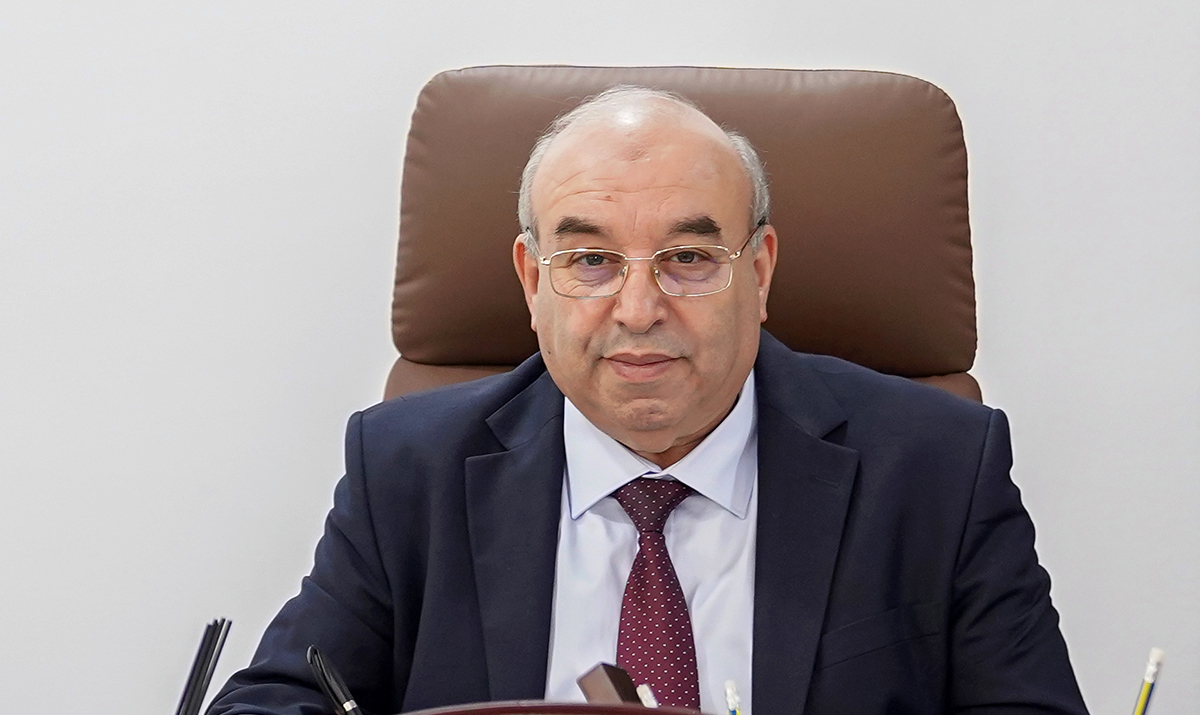
15 Jul Interview with Ouacim Koudri, Minister of Pharmaceutical Industry, Algeria
We know that Algeria’s positioning, or the pharmaceutical sector, is a central pillar in the strategy of diversification. With that, what are your top strategic priorities to further accelerate the development of the industry ?
The pharmaceutical industry in Algeria is relatively new. The Ministry of Pharmaceutical Industry, established in 2020, has been in existence for about five to six years. Previously, this sector fell under the jurisdiction of the Ministry of Health. Before 2020, the rate at which domestic production met the country’s drug needs was estimated at around 54%, although some figures suggested 67%. Today, this rate has reached nearly 80%, or even 83%, reflecting significant progress. Thus, within a few years, domestic production’s coverage of drug needs has seen a notable increase, rising from 54% to over 80%. By comparison, the entire African continent covers only about 5% of its drug needs and less than 1% for vaccines. In this context, the African Union and the World Health Organization have set a target of covering 55% of the continent’s needs by 2035. This is an ambitious goal, even as cooperation efforts begin to take shape with several African countries.
Until 2025, many African countries were unaware that Algeria met approximately 82% of its own pharmaceutical needs. This was partly due to a lack of visibility and communication regarding these achievements. A high-level conference was held in Algeria, bringing together 29 African countries. Following this event, there was a real surge of enthusiasm. Indeed, to achieve the 55% target set for the continent, African countries will need to step up their efforts. During this conference, a common approach was identified. It relies, on the one hand, on exports from Algeria and, on the other hand, on the development of pharmaceutical contract manufacturing for partner countries, directly in Algeria. This strategy builds on existing capabilities. The country has an estimated production surplus of approximately 45%. With nearly 230 production facilities, Algeria alone accounts for more than one-third of the African continent’s pharmaceutical capacity.
Across the continent, there are approximately 645 facilities, more than 30% of which are located in Algeria. The country also has approximately 700 production lines. Certain specialty products remain particularly complex, especially in the sterile sector. Sterile injectables, for example, are produced in Africa primarily in Egypt and South Africa. In the context of pharmaceutical contract manufacturing, a specific approach has been implemented. It relies notably on cooperation between pharmaceutical regulatory agencies. Mutual recognition agreements have been established between Algeria and several partner countries. This approach removes one of the main barriers to export, namely registration procedures, which are often lengthy and burdensome. Thanks to these mutual recognitions, processing times are significantly reduced.
Since the conference, agreements have been concluded with seven countries. The first collaborations will involve Niger and Tanzania in particular. Specifically, these countries will be able to produce their medicines in Algeria, within existing facilities, by sending their teams and receiving support for technology transfer. At the same time, they will be able to develop their own infrastructure, which generally takes between 2.5 and 3 years to establish. These countries will therefore be able to get their operations up and running quickly. They have received support from the African Union and the WHO in building their future production facilities. In the meantime, they will rely on contract manufacturing in Algeria. Specifically, their products will be manufactured locally, using existing facilities.
Each country has a list of essential medicines that it must guarantee. According to WHO standards, this list includes an average of 500 products, compared to about 250 to 300 in Africa. These include, in particular, anticancer drugs, antibiotics and treatments for chronic diseases such as hypertension or diabetes. Today, these products are mostly imported, particularly from India or China. The proposed model allows these medicines to be produced in Algeria while retaining the partner country’s label. Thus, a product intended for Niger, for example, will be manufactured in Algeria. For Algeria, this constitutes an export. For the partner country, the supply is provided under more favorable conditions, particularly due to geographical proximity and costs lower than those of traditional imports. This system is expected to be operational soon.
As part of this effort, a project is scheduled to begin next week with the construction of a facility in Tamanrasset, in southern Algeria, near the countries in question. This initiative is specifically designed to meet the needs of Niger. The state-owned Saidal Group, which represents Algeria’s primary pharmaceutical production capacity, will lead this project. The goal is to develop a facility dedicated to tropical and sub-Saharan diseases, as well as the production of antibiotics, anti-inflammatory drugs and essential medicines. This facility will primarily focus on dry formulations, which are easier to produce. For other products, production will remain based in Algeria. These initiatives are part of a broader trend marked by a significant transformation of the sector since 2020. The main driver has been the authorities’ decision to designate the pharmaceutical industry as a strategic sector — beyond its commercial dimension — by framing it within a public health security framework.
Can drugs manufactured in Algeria be used in the US or elsewhere outside the African continent, or what is required for this to be achieved?
A major reform has been launched to bring production facilities up to international standards. This process is ongoing, with a shift toward recognized certifications, such as European and American standards. Steps have also been taken to obtain certifications such as FDA approval in the US in order to facilitate exports to Africa and other international markets. However, to consolidate these gains, action must be taken at the source. Today, a large portion of raw materials comes from Gulf countries. Nearly 99% of synthetic chemistry relies on petrochemical products. This dependence poses a real supply problem. For example, in France, it was recently reported that certain medications, such as Doliprane, could face shortages if certain tensions persist, due to the outsourcing of their production, particularly to India. In this context, logistical constraints and disruptions to maritime shipping can quickly jeopardize access to these products.
With this in mind, efforts have been made upstream, with the launch of local production of raw materials. Seven projects are expected to come to fruition in the coming months, particularly in the field of acetaminophen. Others involve raw materials for antibiotics, oncology treatments, as well as hormones and peptides. Peptides present a particular challenge. A drug currently imported, primarily for the treatment of prostate cancer, costs approximately $40 million. Local production would reduce this cost to about $5 million. In the field of immunotherapy, certain products also illustrate the scale of the market. A single drug developed by an American company generated $59 billion in revenue in 2023, within a global market estimated at nearly $1.965 trillion and comprising several thousand products. This type of treatment is now produced in Algeria.
Just three or four years ago, it seemed impossible to manufacture this product in Algeria. It was finally developed locally in 2024, even though it had been introduced to the market in 2022. Initially, production was not carried out using the full process, but this goal is expected to be achieved by the end of 2026. Initially, its introduction met with resistance. The medical community did not fully embrace it, largely due to a lack of confidence. Since immunotherapy is generally used as a last-line treatment for refractory cancers, its positioning raised questions. In France, this type of treatment is used as a second-line therapy. Today, in Algeria, it has become a first-line treatment, with 14 indications. In light of these challenges, consultations were initiated at the highest level. The President of the Republic convened several professors of oncology, in the presence of the Minister of Health, to assess the situation. The development of this product, which is particularly complex even for countries with extensive experience in this field, represents a significant breakthrough. Today, this treatment is produced in Algeria. The President of the Republic issued a directive calling for the use of this treatment. Following this, its adoption began gradually. In 2024, approximately 20,000 boxes were released onto the market. The following year, production reached nearly 60,000 boxes at Saidal. By way of comparison, if this product had been imported, the cost would have been approximately $74 million.
Recently, a discussion took place with Professor Kalboua of the Pierre and Marie Curie Center, a leading institution in oncology. Initially, she was reluctant to use this treatment. During this discussion, she was asked about trends in the product’s use. She mentioned a recent case of a patient treated with immunotherapy. Upon receiving the medical records, particularly the CT scan images, confusion initially arose, as the results seemed so unexpected. Her assistant, however, confirmed that these were indeed the records for the patient in question.
She explained that the patient had a large tumor in the lung lobe, which had completely disappeared. She thus confirmed the product’s effectiveness. This treatment is set to be exported. In the short term, the goal is to offer it to other markets, particularly in Africa, where immunotherapy remains underdeveloped. Furthermore, full-scale production of this type of treatment is not currently mastered on a large scale, neither in the Middle East nor in Africa.
Regarding vaccines, a partnership is underway with Abbott. The process began with a secondary packaging phase, as part of the technology transfer. Indeed, each pharmaceutical product constitutes a project in itself. The flu vaccine, which accounts for the largest volume in Algeria, was chosen as the starting point. The work with Abbott has been underway for two years and is currently in the technology transfer phase. This year, production will move to the “fill and finish” stage, before reaching the full process next year. These initiatives are part of a broader strategy, which also includes the development of cell therapy.
As Algeria and the African continent develop further, there is an increased risk of chronic diseases rising among populations. How do you see the overall population health and what can be done to manage chronic diseases quickly, economically and with local production?
Regenerative therapy targets conditions such as Parkinson’s disease, Alzheimer’s disease and vitiligo, for which treatment options have been limited until now. In other countries, these treatments are already beginning to be developed. Certain players are particularly advanced in this field, notably in the United States, in Sweden with the Karolinska Institute — which awards the Nobel Prize — as well as in Switzerland. In this context, Saidal, as a public company, has established a partnership with the Karolinska Institute, as well as with American and Chinese partners, the latter also being highly advanced in these technologies.
Regarding diabetes, projects were initially considered, notably the production of insulin crystals, i.e., the raw material. However, recent advances in the treatment of type 1 and type 2 diabetes suggest, in the medium term, a reduction in the use of insulin. These developments illustrate the rapid pace of change in the sector. The US currently holds a leading position in cell therapy and several partnerships have been established with US entities. In addition, agreements have also been signed with a US laboratory for the production of blood products.
With regard to strategic priorities to support development, five major areas have been identified. The first concerns upstream integration, particularly through the production of APIs. The second area focuses on moving upmarket. Previously, the business relied primarily on generic drugs. Now, a shift toward research and development is underway, particularly in biotechnology, cell therapy, biosimilars, anticancer drugs and vaccines. A third area concerns the development of an export strategy. In this context, to facilitate access to African and international markets, the WHO requires a minimum level of regulatory maturity, ML3. To date, this level has been achieved 95%, with an audit scheduled for June. According to assessments already conducted, notably by Swiss experts, the level achieved is high, suggesting that validation will proceed without difficulty. Ultimately, once this level is stabilized, the goal is to reach ML4, equivalent to US FDA standards. This level remains relatively uncommon on a global scale.
Reforms have also been implemented at the management level, with a complete digitization of processes. Within the ministry, operations now rely entirely on digital platforms, with no use of paper. At the pharmaceutical agency, which reports to the ministry, digitization is about 80% complete. By the end of the year, all procedures will be fully digitized. This transformation ensures greater transparency. For example, when obtaining approval or marketing authorization, deadlines are strictly enforced. If a decision must be made within three months, it must be made within that timeframe, with alert systems in place in case of delays. All of these factors contribute to making the Algerian market more attractive by enhancing its visibility and clarity.
The country has a population of approximately 45 million, benefits from an extensive social security system and is experiencing rising drug consumption. Since access to healthcare is largely covered, demand remains strong. Furthermore, the pharmaceutical industry is well-structured and rapidly evolving. Numerous production facilities are in operation and are undergoing audits to meet international standards, including GMP and IMI certifications and, eventually, US FDA standards. These audits are conducted by both national and international authorities, reflecting a strong drive toward modernization and opening up to foreign markets.
Algeria builds a fully integrated pharmaceutical value chain from raw materials to finished products where do you see the greatest opportunities for collaboration with US companies?
For US companies, opportunities lie primarily in the upstream sector, particularly in research and development, biotechnology and vaccines. Collaborations have already been established in these areas, particularly regarding training and innovative products, notably for the treatment of cancers — especially refractory cancers — as well as rare diseases. US companies possess recognized expertise in these fields. The goal is not to pursue a purely commercial approach, but to establish partnerships that include technology transfer over several years.
In contrast, collaborations have been successful with Abbott, as well as with other partners involved in cell therapy and blood product manufacturing projects. In the latter area, the stakes are high. Imports of immunoglobulins and blood factors amount to approximately $200 million per year. Establishing local production would reduce this cost to about $65 million, with a significant decrease in the import bill. More broadly, thanks to the 82% national coverage rate, the total cost of pharmaceutical imports has been reduced from $1.25 billion to approximately $500 million — a decrease of nearly 60%. In this context, partnerships with US stakeholders remain essential, particularly in the areas of research, innovation and cutting-edge technologies, where their expertise is particularly advanced.