
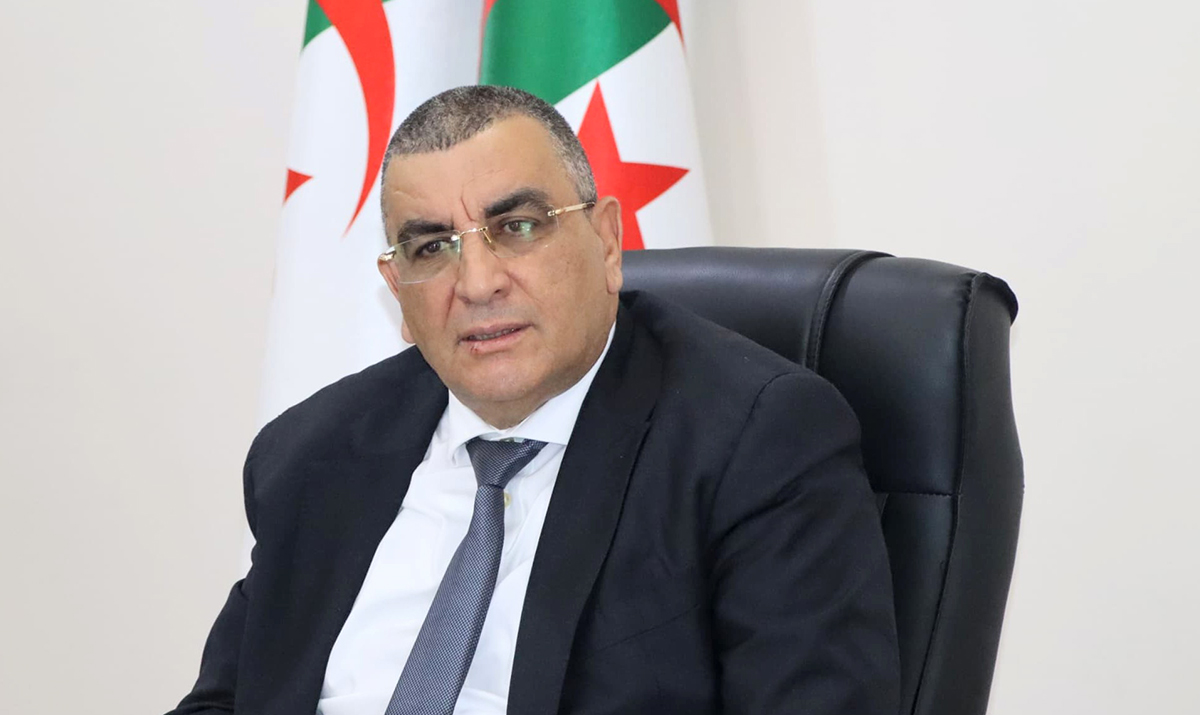
15 Jul Interview with Mr. Abdelkader Djellaoui, Minister of Public Works and Basic Infrastructure, Algeria
Algeria has undertaken significant infrastructure investments in recent years. How is the ministry approaching the measurement of their economic impact, particularly in terms of productivity, trade costs and export competitiveness?
Infrastructure is the fundamental prerequisite for any socio-economic development and the primary driver of any lasting economic transformation. Under the leadership of President Abdelmajid Tebboune, Algeria has made this a matter of state conviction — translated into concrete, measurable actions deployed across the entire national territory, with a constant commitment to regional balance. This priority aims to correct spatial disparities, stimulate local development and ensure national cohesion in service of a competitive and attractive regional space.
The infrastructure heritage we manage today bears powerful testimony to this effort: 90,000 miles of road network, 1,000 miles of motorways, 3,565 miles of railway lines, 52 ports and 51 aerodromes. This foundation is the result of sustained and planned effort. Between 2020 and 2025 alone, the rail network grew by over 1,000 miles — from 2,528 to 3,565 miles — now connecting 40 wilayas, compared to 35 in 2020. Over the same period, 300 miles of roads were widened, 231 miles of new roads were opened to traffic and a further 334 miles were modernized — achievements complemented by the maintenance of approximately 5,219 miles of national roads and wilaya roads.
The clearest illustration of this development ambition is the commissioning, in January 2026, of the Western Mining Railway Line —590 miles-long Béchar to Gara-Djebilet via Tindouf. This achievement forms a major integrated mine-rail-port logistics chain, designed for the production and export of high value-added steel products to international markets. Its counterpart currently under construction: the 262 mile double-track Eastern Mining Line, with a capacity of over 25 million tons per year, which will extend this same logic of leveraging national mineral wealth and enhancing export competitiveness toward the phosphate deposits of the country’s eastern region.
The economic rationale underlying these investments is precise and measurable. The efficiency of this infrastructure, combined with an optimal multimodal network, generates a chain of direct and quantifiable effects: reduced passenger and freight processing times, lower transport costs, improved traffic flow yielding savings on vehicle operating costs and faster delivery of raw materials and goods. All these efficiencies, combined with shorter delivery times, translate directly into higher business productivity, reduced commercial costs and stronger export competitiveness thereby fostering sustainable and inclusive economic growth. Algeria builds to serve the domestic market, to export, to compete and to establish itself as an indispensable regional hub connecting Sub-Saharan Africa, the Mediterranean basin and global markets.
The Trans-Saharan Trade Corridor is emerging as a central pillar of Algeria’s regional strategy. How is your Ministry advancing this initiative to drive sustamed trade flows and export expansion across African markets?
For decades, Algeria has been connecting Africa with a clear and deliberate geostrategic vision. In this continental project, the public works sector plays a central and operational role: to develop and modernize infrastructure in order to guarantee fluid, reliable and sustainable commercial flows. The Trans-Saharan Highway is the most accomplished expression of this ambition. This network of nearly 6,213 miles — the backbone of trade between North Africa and Sub-Saharan Africa — is fully built and paved on Algerian territory along its main axis from Algiers to the Nigerien border, spanning 1,454 miles.
This is not a project; it is an operational reality in continuous improvement. Already, 325 miles have been developed to motorway standard between Algiers and Ghardaïa. The progressive upgrade to a full motorway corridor will continue over the 155 miles between Ghardaïa and El Ménéa, for which studies have been entirely finalized. Along the stretch between El Ménéa and the Algerian-Nigerien border, modernization and road reinforcement works have been launched over more than 500 miles showing signs of deterioration, in order to ensure the reliability and continuity of this strategically vital commercial and economic corridor.
Trans-Saharan connectivity does not rest on a single axis. Two national roads serving as North-South arterials — RN03 in the East and RN06 in the West — are included in annual programs for modernization, reinforcement and duplication according to traffic levels, multiplying the available commercial exchange routes with the continent. To ensure the flow of goods and products from ports and airports, the construction of motorway access roads connected to our East-West Motorway is underway, while the main structuring routes are subject to modernization programs and the treatment of intersection points through appropriate engineering works, eliminating traffic conflicts and improving the fluidity of flows.
Beyond the main road axis, Algeria has built a genuine network of African connectivity: the Tunisian branch is fully paved over 318 miles; for the Malian branch, 248 miles out of 338 have been completed; and in terms of bilateral access routes, 472 miles have been finalized toward Mali and 351 miles toward Niger. These routes are not mere transit corridors, they are the commercial arteries that enable Algerian goods and the produce of the entire Sub-Saharan region, to circulate, be exchanged and reach markets.
The expansion of the national rail network, guided by presidential directives, continues its deployment along the strategic Algiers-Tamanrasset axis over a distance of 1,246 miles and its connection with the Northern and Deep South lines, with the aim of contributing to the opening up of isolated areas, economic development and national integration, while fostering regional and trans-Saharan exchanges. Algeria has invested in this continental infrastructure because it knows with certainty that prosperity is built through connectivity. A country that connects its neighbors is not engaging in geopolitics, it is building an economy and that economy is already in motion.
Given Algeria’s strategic position between Africa, Europe and the Mediterranean, how is the ministry shaping a multimodal logistics strategy that integrates road, rail, ports and air transport?
If geography is a destiny, Algeria has chosen to turn it into an opportunity. A natural crossroads between Mediterranean Europe, North Africa and the Sub-Saharan region, our country occupies a strategic position whose full economic potential rests on an integrated multimodal infrastructure — developed on the basis of a National Territorial Planning Scheme, a multisectoral and integrative approach designed to address the country’s socio-economic development policy in its entirety. Given Algeria’s geographical position, the largest volume of commercial trade transits by sea — a reality that has guided our investment priorities. Accordingly, port capacity expansion projects have been launched to equip the country with modern infrastructure capable of absorbing the full anticipated volume of maritime traffic.
To maximize the impact of these new capacities, 70 miles of motorway access roads have been delivered, directly connecting the strategic ports of Djen Djen, Béjaïa, Oran and Ghazaouet to the national motorway network, eliminating freight breaks and logistics costs that penalize the competitiveness of operators. The next stage of this integration is the development of multimodal logistics platforms connected to these access roads, which will transform our port zones into genuine value-added trade hubs.
In the same logic of modal integration, the 590-mile Western Mining Line, inaugurated in January 2026, merges rail and port into a single integrated corridor: iron ore extracted at Gara-Djebilet reaches processing plants and export ports via rail — a model of a vertically coherent logistics chain. The ore terminal at the port of Annaba, expected to be operational in March 2027, will complete in the east this same mine-rail-plant-port architecture, serving the phosphate deposits and supporting the development of a wide range of industrial and agricultural activities. Algeria is building the links of a continental logistics chain, anchored in a coherent and multisectoral territorial planning vision, in which every segment reinforces the competitiveness of the whole.
Ports are critical gateways for trade. What key initiatives are underway to enhance efficiency, reduce bottlenecks and further strengthen Algeria’s port competitiveness?
An inefficient port is a border in disguise. Algeria has recognized this and has embarked on a structural transformation of its port infrastructure-conceived not as a renovation, but as a complete competitive repositioning in service of a clear vision: to make our ports genuine modern logistics hubs, capable of supporting the diversification of the national economy and progressively reducing our dependence on hydrocarbons. Our maritime coastline represents many entry and exit gateways for our economy. The competitiveness of these gateways depends on two inseparable conditions: their efficient connection to inland networks and their intrinsic capacity to process flows quickly and at reduced cost. On both fronts, the initiatives are concrete, committed and measurable.
On the intermodal connectivity front, over 70 miles of motorway access roads have been delivered, directly linking the strategic ports of Djen Djen, Béjaïa, Oran and Ghazaouet to the national network. Eliminating freight breaks between the port and the motorway means eliminating lost hours, unnecessary costs and discouraged clients. On another front, reinforcement works on berthing structures have been carried out at the commercial ports of Algiers and Djen Djen, while dredging and rock-clearing operations have been conducted at Annaba and Dellys-Boumerdes, ensuring navigability and the capacity to accommodate vessels with greater draft.
In parallel, we are actively working on reducing port transit times, on the digitalization of procedures and on better organization of logistics flows between the port and its hinterland — levers of performance every bit as decisive as concrete and steel. On the front of capacity, specialization and international ambition, three projects deserve particular mention: The ore terminal at the port of Annaba, developed as part of the Integrated Phosphate Project, which will enter into service at the end of March 2027: it will significantly increase our export capacity and support the development of an internationally oriented industrial sector, a perfect illustration of the integrated mine-rail-port chain we are architecting. The port of Arzew, which is undergoing capacity reinforcement, with two new berths scheduled to enter service as early as the first quarter of 2026, improving traffic flow and supporting the development of port activities in the Western region. The Djen Djen port extension project, whose studies are in the process of being finalized, will equip the port with infrastructure meeting international standards, with a handling capacity exceeding five million containers per year — making it a genuine Mediterranean transhipment hub, capable of capturing a significant share of regional maritime flows and positioning Algeria as a major logistics actor in the Mediterranean.
In summary, a port that processes quickly, accommodates high-tonnage vessels, is connected to motorways and the national rail network and whose procedures are fully digitalized is a competitive port. This is precisely the model we are deploying, port by port, along our entire maritime coastline.
With major railway expansion projects underway, how is Algeria leveraging rail development to enhance freight efficiency and strengthen connections between inland production centers and export markets?
Rail is the backbone of any serious industrial economy. Algeria has chosen to make it the framework of its future competitiveness — a choice guided by the directives of the president and planned around a dual strategy: on one hand, a national strategy grounded in the National Territorial Planning Scheme, aimed at strengthening mobility, supporting economic growth and ensuring balanced territorial development; and on the other hand, an international strategy based on adapting the rail network to regional and transcontinental connections.
In the space of just five years, between 2020 and 2025, the national rail network grew by 1,038 miles, now connecting 40 wilayas. This pace of expansion has no equivalent in the recent history of African infrastructure. The scale of the ongoing program confirms that this momentum is far from over: 672 miles of new lines and 494 miles of track doublings are under construction; 2.031 miles of studies have been finalized and are ready for the execution phase; and a further 1,908 miles are currently under study.
The network is structured around six major corridors: the Northern Loop spanning 1,132 miles; the Highlands Loop spanning 650 miles; the Western Mining Line spanning 590 miles with its planned extension toward the ports of Oran, Arzew and the Bethioua industrial zone; the Eastern Mining Line spanning 262 miles; the Algiers-Tamanrasset Penetrating Line spanning 1,246 miles; and the Southern and Deep South Lines covering more than 932 miles.
The economic logic at work is precise. Rail, particularly well-suited to mass transport over long distances, produces a direct chain of effects: reduced logistics costs, increased export capacity, smoother supply chains and optimal complementarity with road transport. It stimulates inter-regional trade, facilitates business access to markets and resources, opens up rural areas, reduces territorial inequalities and generates significant environmental savings through the reduction of CO2 emissions and road congestion. Strategically, it is an engine of economic growth and sustainable development. The rail connection of the ports of Djen Djen, Béjaïa, Annaba and Oran to the national network perfectly illustrates this integration vision-linking ports, industrial zones and interior regions within a single, high-performance logistics system. The most striking demonstration remains the Western Mining Line, inaugurated in January 2026: 590 miles linking Béchar to Gara-Djebilet, designed to carry 55 million tons of raw iron ore and 55 million tons of processed products annually. Its eastern counterpart, currently being doubled and modernized, will enable the transport of 25 million tons of phosphates per year — including fuel and cereals — transforming landlocked deposits into exportable assets on an international scale.
In parallel, the progressive connection of industrial zones, business parks and grain silos is improving the fluidity of domestic freight across the entire territory. On the North-South axis, the strategic Algiers-Tamanrasset corridor with 191 miles already in operation, 26 miles under construction, 376 miles of works to be launched between Laghouat and El Ménéa and 652 miles of finalized studies covering the section from El Ménéa and In Saleh through to Tamanrasset consecrates a vision of continental connectivity that will position Algeria as the natural logistics hub for trans-Saharan trade with Niger and Sub-Saharan Africa, supporting industrial diversification, securing commercial flows and fostering regional integration on a continental scale. Every mile of rail laid in Algeria brings a mineral deposit closer to a port, an industrial zone closer to a market, a producer closer to an international buyer. A network with an undeniable power to drive economic transformation.
Projects such as the planned monorail in Algiers reflect a shift toward integrated urban mobility. How do you see these investments contributing to productivity, quality of life and the attractiveness of Algerian cities?
Indeed, the concept of a monorail project in Algiers is among the intermediate urban transport solutions in terms of cost and transport capacity that have been proposed as part of the decongestion plan for the greater Algiers metropolitan area and whose feasibility studies will be launched shortly within the framework of a comprehensive urban mobility vision. A city where people can move freely is a city that produces, attracts and radiates influence. Urban mobility is the invisible infrastructure underpinning the daily productivity of millions of citizens and the most legible barometer of a metropolis’s modernity.
Algeria has embarked on a profound and methodical transformation of its urban transport systems. The results are today concrete and quantifiable: 21 guided transport systems, over 80 miles of urban rail lines in service, 267 operational metro and tram units, serving 197 passenger stations across seven wilayas – Algiers, Oran, Constantine, Sidi Bel Abbès, Sétif, Ouargla and Mostaganem. The Algiers Metro, the backbone of this network, operates 12 miles of line and 19 stations using 26 trainsets, with extensions whose civil engineering works have been completed across an additional 8.6 miles of tunnels ready for commissioning and a long-term target of 40 miles and 58 stations.
In addition to the tram networks, 13 cable transport systems have been deployed in cities with complex topography, providing an adapted, innovative and cost-effective response to the challenges of connecting elevated neighborhoods.
Algeria is advancing digital platforms to monitor public infrastructure projects in real time. How will these tools further enhance project delivery, transparency and overall investor confidence?
Investor confidence cannot be decreed – it is built, data point by data point, decision by decision, through tools that demonstrate the state knows exactly where its projects stand, in real time. It is precisely this requirement that has led the Algerian Government to engage in a profound digital transformation of its infrastructure management, monitoring and oversight processes. An integrated information system comprising 20 operational modules has been deployed on a single, centralized platform, covering all operational functions of the sector. The secure digital network underpinning it currently connects 62 sites linked via a site-to-site VPN solution, with effective interoperability across several ministerial departments — civil registry, higher education and the commercial register ensuring the consistency and reliability of data across the administration.
In the field, geolocation and real-time traceability tools are transforming the way projects are monitored and controlled. The Railway Geographic Information System, developed by ANESRIF, integrates the land parcel plans of all railway projects, ensures complete traceability of studies from their identification through to the detailed preliminary design stage and enables real-time progress monitoring through geolocated photographs, eliminating the opacity that historically represented the primary barrier to the confidence of external partners. In the same spirit, the Motorway Geographic Information System of the ADA, currently in its deployment phase, will enable the continuous capture, storage and analysis of geographic data across the entire national motorway network. On the road front, SAGER — the road maintenance management system is in the process of being finalized, while the SGA, the airport management system, follows the same timeline, thus completing a digital coverage that now extends from rail to air, encompassing road infrastructure in between.
For an international investor, the question is never abstract — it is simple and direct: where does my project stand, who is accountable for it and what happens if a deadline is at risk? The digital tools we are deploying provide a documented, traceable and verifiable answer to each of these questions. Transparency ceases to be a posture and becomes an architecture.
As Algeria strengthens its infrastructure and trade connectivity, how do you see opportunities for deeper engagement with US companies and investors, particularly in areas such as logistics. engineering and digital infrastructure?
Great investment opportunities are never announced – they are read in the figures, in the projects underway and in the trajectory of a country that has decided to build on a grand scale, with seriousness and method. Algeria offers American companies and investors a rare engagement opportunity today: a sovereign, solvent market, equipped with a clearly articulated long-term infrastructure vision and a critical mass of concrete projects awaiting partners equal to their ambition.
In terms of logistics and transport engineering, the national railway program represents a construction effort of exceptional scale. With 672 miles of new lines under construction, 2,031 miles of completed studies ready to move into the execution phase and an ambition to expand the network to over 9,300 miles in the long term, the needs in specialized engineering, railway signaling systems, telecommunications equipment and traffic management solutions are considerable. American companies — globally recognized leaders in these fields will find in this program a terrain for the expression of their technical excellence at a scale that fully justifies long-term investments. Our 1,000 mile motorway network, including 14 access roads currently under construction, as well as the modernization and extension projects across our 52 ports — notably the deep-water port in the central region, whose study has been scheduled — open equally significant prospects in maritime engineering and multimodal logistics design.
On the digital infrastructure front, the opportunities are perhaps the most immediate and the most structurally significant. Our integrated information system of operational modules, our secure network covering connected sites, our railway and motorway geolocation systems currently being deployed — all of this represents only the first stage of a digital transformation whose true scale still lies ahead of us. American technology companies and providers of large-scale infrastructure project management solutions will find here a market under construction, in the most literal sense of the term, that awaits their solutions and expertise. Our sector also benefits from two specialized schools: ESMTP in Sidi Abdellah and EMTP in Djelfa, which constitute natural platforms for academic partnerships and skills transfer with leading American institutions.
Finally, Algeria’s geographical positioning deserves to be highlighted in its full dimension as an opportunity for the American investor: a country that connects Mediterranean Europe to the fast-growing African markets, that operates world-class mineral deposits — iron, phosphate, zinc — and that possesses a rapidly expanding infrastructure network, represents for an American company not merely a local market, but a strategic gateway to a continent of 1.4 billion consumers. Algeria is seeking partners. Partners who bring technology, operational excellence and a long-term vision. American companies fit this profile exactly. The question is no longer whether the partnership is possible, it is rather who will be visionary enough to seize it first.