
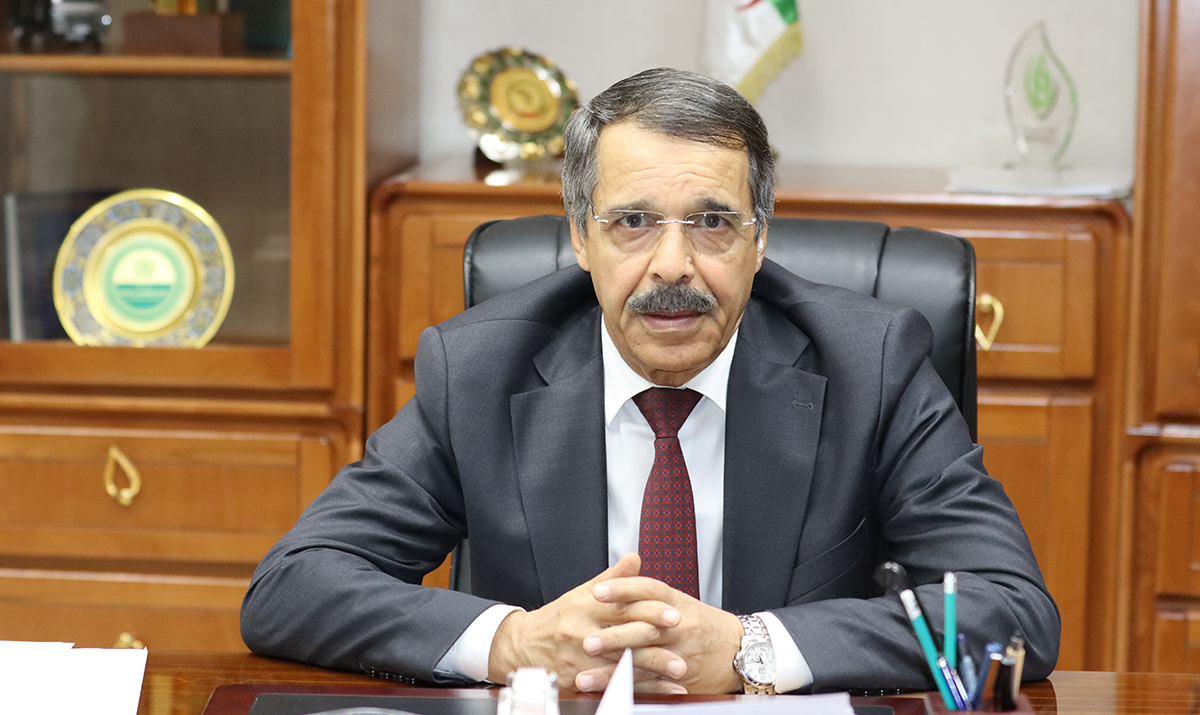
15 Jul Interview with Abdelkrim Bouzerd, Minister of Finance, Algeria
Congratulations on the new finance law that was adopted with an overwhelming majority, reflecting strong institutional consensus. What were the key reforms within the law that made this level of support possible and what does it signal about Algeria’s economic direction going forward ?
The budget law is a pivotal moment in a country’s economic life, particularly in Algeria. A significant portion of the population awaits its publication to learn about the measures adopted by the government — and subsequently approved by parliament — and to assess their impact on daily life. As such, the budget law remains a central element, both economically and politically. This year builds on a process initiated since the president took office, aimed at injecting new momentum into the conduct of public affairs, particularly in the economic sphere. The 2026 Finance Act is fully in line with this political commitment.
To summarize its main points, the bill is based first and foremost on the continuation, with even greater intensity, of the government’s investment initiatives. Second, it aims to maintain and improve the living standards of the population, particularly by preserving purchasing power. This involves fiscal measures, as well as the continuation of existing programs, with the goal of fiscal stability to keep market prices in check. Third, specific measures have been introduced. One of these concerns the broadening of the tax base through a voluntary regularization procedure for taxpayers who have not fully met their tax obligations. This is a first and a notable feature of this law.
Furthermore, regarding resource mobilization, another innovation is worth noting: for the first time, treasury bond issues will be structured in accordance with Islamic finance principles. The goal is to expand financial inclusion. Indeed, in a country with a Muslim majority, a portion of the population remains reluctant to engage in conventional banking, which they do not always consider to be in line with the principles of Islamic finance. This initiative aims, in particular, to attract a portion of the savings held outside the banking system. Indeed, some people prefer not to deposit their funds in banks, believing that the financial products offered do not align with their beliefs. This transaction has made it possible to integrate these resources into the financial and banking sectors, in line with the goal of financial inclusion.
The Finance Act therefore introduces this innovation, in addition to tax regularization. It also provides for the relaxation of several rules and procedures, benefiting businesses, the economy and citizens. Furthermore, this law is being implemented within a macroeconomic environment deemed favorable. Key indicators point to a degree of stability: inflation is under control, the currency is stable and the external accounts remain broadly balanced. Foreign exchange reserves cover several months of imports, which strengthens the country’s external position. In this context, the Finance Act aims to consolidate the economic and financial situation.
Algeria is implementing a fully digitalized financial administration, including budget exclusion and asset registry, which is helping record levels of public investment on their way. How will this digital transformation change the way the state monitors spending and manages public resources ?
Digitization is now a term widely used in government agencies and businesses. When addressing this issue, it is important to first discuss the establishment of the necessary infrastructure. Progress has been made, particularly in the digital transformation of government. In the case of the Ministry of Finance, this challenge has been successfully met, despite the delays that had accumulated in previous periods. For example, the digitization of land records has made it possible to create reliable databases on citizens’ real estate holdings. It has also contributed to the digitization of tax records.
The same applies to taxation, where records have been gradually digitized to ensure better oversight, improve service delivery, strengthen tax collection and, consequently, financial inclusion. The digitization process, particularly within the Ministry of Finance, is also expanding to other areas. For example, customs authorities have also embarked on this transformation. Digitization is now well advanced there and management is largely automated.
These developments affect the financial administration, but also other sectors. With regard to citizens and market operations, progress is also being made in the financial sphere. However, this requires a period of adjustment, particularly in terms of users’ adoption of financial services. In this context, the development of electronic payments, through the use of bank cards, is part of a broader effort toward financial inclusion and transparency. For several years now, the government has been working to modernize the financial system, financial activities and the relevant institutions.
Algeria is the largest country in Africa. It is also a major economic player on the continent thanks to its natural gas and oil reserves. How do you think Algeria can specifically strengthen economic cooperation among African countries?
It is clear that Algeria has always attached particular importance to its position in Africa, as an African country with natural ties rooted in that region. For several years now — and particularly since 2020, despite the challenges posed by the COVID-19 pandemic — a significant portion of the government’s efforts has been devoted to strengthening relations with the African countries that constitute its natural sphere of influence. For example, a week ago, a significant delegation from the government visited Niger, illustrating the strength of this focus and this perspective. A few months ago, the Inter-African Fair held in September also generated significant enthusiasm. Thus, Algeria’s role in Africa is rooted in strong relationships, particularly with the countries of the Sahel.
Furthermore, major infrastructure projects are reinforcing this momentum. Among them is the development of the railway network toward the Far South, a project that, just a few years ago, seemed hardly conceivable. In the past, the south was primarily associated with tourism. Today, political will and the programs implemented have made it a strategic priority, with the goal of further connecting Algeria to its neighboring African countries. These include Mali, Niger and Mauritania. As part of this effort, an ambitious program to build railway lines is underway, with the aim of extending the network to the country’s borders.
Furthermore, Algeria’s role is also reflected in its assistance efforts on behalf of several African countries. This involves not only investments but also contributions in the common interest. For example, a power plant was recently donated to Niger. Other initiatives are also underway, notably in Chad. Algeria is aware of its role in Africa, its relations with the countries of the continent and the importance of shared interests. It is also worth noting that certain populations in the South maintain historical and family ties with people living across the border. For instance, the current Prime Minister of Niger has family in Algeria.
What would be the final message you’d like to share with our readers — who may be potential investors — as well as with the US government?
Algeria is a country open to all. Investment opportunities are plentiful and well-established. It is possible to establish a presence there as an economic player in the local market, but also to view Algeria as a springboard to other markets.
Algeria currently has approximately 47 million consumers. Domestic production is approaching $250 billion. There is therefore a real market. Investment potential remains partially untapped — at 30-40% — whether in industry, agriculture, or tourism, excluding the hydrocarbons sector. The message is that the advantages for an investor are very much present in Algeria. There is both a significant local market and a strategic geographic location. The country is located about an hour’s flight from Marseille, not to mention its proximity to Spain and other destinations. Several factors thus give Algeria advantages that few countries possess. Finally, an investment incentive system exists, comparable to that of other countries, with measures considered attractive.
Many people are surprised when they learn that hydrocarbons now account for less than 30% of the country’s production and government revenue. Yet this is the reality. Other sectors are becoming increasingly important. Agriculture, for example, accounts for about 25%, while the industrial sector stands at around 18%, with rapid growth expected, driven by a significant volume of ongoing investments. On this subject, a Saudi operator told me about 15 years ago that despite the complexity of certain administrative procedures — which, incidentally, have since evolved — Algeria remained a country where it is possible to achieve significant results. This is a factor to consider in the message addressed to potential investors.
Furthermore, another point deserves to be highlighted. Despite the criticism sometimes leveled at the education system, Algeria produces approximately 250,000 higher education graduates each year. What is also interesting is the changing profile of students. At one time, liberal arts programs dominated. For example, in a single graduating class, there might be about 150 economics students, compared to barely 30 in technical or engineering programs. Today, the trend has evened out. This means that there is now a skilled workforce, particularly in technical fields, ready to be tapped by investors, provided they receive support and training. The large number of Algerians living abroad is further evidence of this. The message is therefore clear.